Speech of 2025/10/03 in Athens by George Konstantinou from Supreme Council of Ethnikoi Hellenes (YSEE) in Cyprus

"The Strategy of Ethnic Religions in Europe"
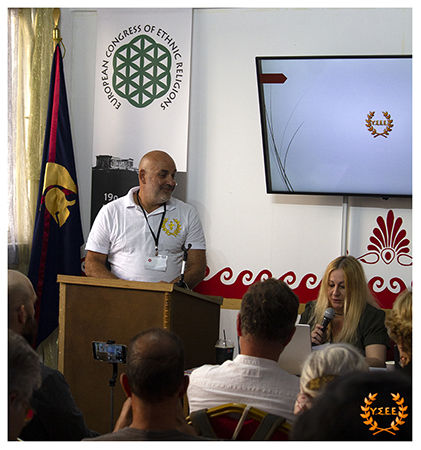 When we speak about Europe, we often speak of economy, institutions, and politics. But the soul of Europe is its culture – and this is precisely where the ethnic religions come in. Ethnic religions are living cells of the European identity. Their contribution is not confined to historical memory; it shapes the present as well, offering values, culture, and spirituality that can enrich our common European home.
The challenge before us is how to make use of the opportunities offered by the European Union, without losing our soul, our authenticity, and our unique cultural contribution. This is the core of our path and, at the same time, the way in which ethnic religions can strengthen and enrich the very identity of Europe.
1. Opportunities
The European Union provides tools that we can use creatively, integrating ethnic religions into the broader European cultural landscape.
As YSEE Cyprus, we have already secured funding for the creation of facilities in worship spaces, such as restrooms accessible to people with disabilities. A practical project, but also deeply symbolic: it shows that ethnic religions can be modern, open, and inclusive. Beyond this, there are significant programs such as: The “Creative Europe” program, which encourages collaboration among organizations from many countries to create cultural initiatives. Imagine a pan-European festival of ethnic religions, where hymns, rituals, and traditions stand side by side, showing how our spirituality contributes to Europe’s cultural diversity. The UNESCO programs, in which we have already sought to participate. They do not only provide financial support; they primarily ensure international recognition and institutional protection for our traditions. So far, we have faced rejection. But for us, the matter does not end here. We remain present and continue our efforts. We have already submitted an appeal and are requesting a reconsideration. Because when our traditions are excluded, it is not only us who lose; it is Europe itself, deprived of a voice that could enrich the common narrative.
National subsidy programs, such as those of the Deputy Ministry of Tourism, which can support festivals and cultural events.
We have already secured support for one such project, with a subsidy of 18,000 euros.
Another effort to join a European program is through the call announced by the Department of Contemporary Culture of the Deputy Ministry of Culture: the program of “Accompanying Events in Cyprus during the Cyprus Presidency of the Council of the EU in 2026.”
Participation in such initiatives will give us the opportunity to present our traditions both in Cyprus and across Europe, gradually becoming established within society. Our proposal for this program is the performance of ancient Greek hymns – sounds that resonated thousands of years ago and can once again be heard by European audiences.
Finally, conferences like today’s are not merely academic gatherings; they are platforms where ethnic religions gain a voice, take part in shaping policy, and are recognized as contributors to the common European narrative. Through participation in European programs, this voice can be heard more clearly in society and in the highest institutions of the European Union.
2. Concerns
Yet, alongside opportunities, there are also risks. The European Union often speaks of a “cultural mosaic.” But there is always the risk that this mosaic may become a colorless whole, where our differences are assimilated in the name of a superficial unity. The contribution of ethnic religions to European identity is not to make us all the same. It is to show that Europe’s identity is built through diversity, through the equal presence of many voices.
3. Cultural Diplomacy
In this context, ethnic religions must function not only as religious communities but also as cultural ambassadors of Europe. Through festivals, music, rituals, and artistic expressions, we can: showcase our unique identity, strengthen interreligious and intercultural dialogue, contribute to Europe’s cultural diplomacy. In this way, our contribution is not confined within our national borders; it becomes part of the European identity as a whole.
4. Strategic Pillars
Our strategy for the contribution of ethnic religions to the shaping of European identity rests on three pillars:
→ Creative use of European and international resources for projects with substance.
→ Strengthening cooperation among ethnic religions, based on respect and solidarity.
→ Constant vigilance against assimilation, while highlighting our cultural contribution through cultural diplomacy.
These three pillars are not theoretical goals; they are our practical roadmap for the years to come.
Our path is not simply to survive within the European framework. It is to show that Europe’s unity can only be built upon diversity. The programs of the EU, UNESCO, and national funding schemes are opportunities we must seize. But the real challenge is to keep our identity alive and to demonstrate that our voice carries value and perspective for all of Europe. Ethnic religions do not merely ask for space in Europe; they bring light, memory, and future. And Europe is more complete when our voices are united.
Thank you for your attention