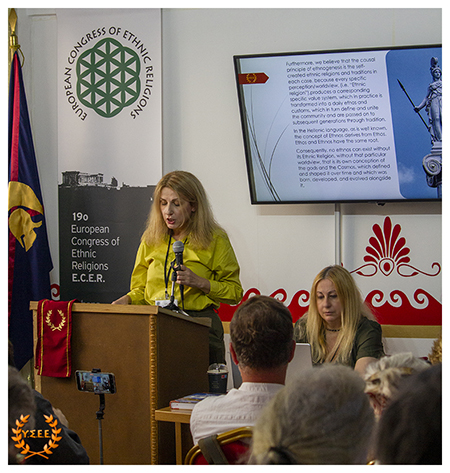
Speech of 2025/10/03 in Athens by Eleni Antigoni Xanthi, Priestess of Hellenic Ethnic Religion & Member of Board of YSEE

"The contribution of ethnic religions to the formation of European identity"
Read the speech in Hellenic Language
 Dear colleagues, members of ECER (European Congress of Ethnic Religions) and distinguished guests,
I welcome you and wish those who have traveled from afar a pleasant stay in the sacred city of Athens. I also hope that this conference will be inspiring, creative, and beneficial for all of us.
This year's theme for the conference on European religions is «the contribution of ethnic religions to the formation of European identity». Let us try to define the two basic concepts that constitute the question.
One is the concept of ethnic religion, which we will clarify further, since almost all of us here belong to one of these religions and because we believe that the broader understanding of Gods and the Cosmos is what determines human beings' relationship and position both within the Cosmos and within the community.
In modern terms, we could define this fundamental conception of the Cosmos as "religion," in the sense of a worldview and its subsequent reflection in the public and private "being" and "becoming," which includes the development of an Ontology and a corresponding Theology. We recognize that this concept corresponds to an innate tendency in humans (such as the search for the Divine, awe for the Sacred), which we could call "religious sentiment" or "religiosity."
Furthermore, we believe that the causal principle of ethnogenesis is the self-created ethnic religions and traditions in each case, because every specific perception/worldview, (i.e. " Ethnic religion’’),produces a corresponding specific value system, which in practice is transformed into a daily ethos and customs, which in turn define and unite the community and are passed on to subsequent generations through tradition.
In the Hellenic language, as is well known, the concept of Ethnos derives from Ethos. Ethos and Ethnos have the same root.
Consequently, no ethnos can exist without its Ethnic Religion, without that particular worldview, that is its own conception of the gods and the Cosmos, which defined and shaped it over time and which was born, developed, and evolved alongside it.
But, what constitutes European identity, common to all European citizens? Is it the distinctive features of a political entity such as the European Union, its institutions, the status of European citizenship that provides the possibility of free movement, residence, and work? Is it the common historical past of the peoples? Is it the sense of belonging to a specific geographical context? Is it perhaps the principles and values shared by European ethnic traditions?
We modern Europeans have inherited achievements, political realities, perceptions, and traumatic experiences from the past, and we have managed to put aside our differences and reconcile, as far as possible, removing the clouds of war from European soil.
European identity does not have a commonly accepted definition. It is a dynamic concept, evolving and adapting to circumstances.
However, under no circumstances, can it be identified with Charlemagne's united Christian Europe (8th-9th centuries CE), as the European Union seems to desire.
This choice is more of a "founding myth" of expediency, which seeks to limit the common European tradition and identity to the historically recent-violently Christianized version of Europe of the theocratic Middle Ages, overlooking and denigrating, to the point of extinction, not only the authentic and historically long-standing pre-Christian tradition, but also the subsequent Europe, of the Renaissance of Free Thought and Enlightenment, which led to the modern secular state and human rights, and furthermore does not even include all the peoples of Europe (such as those of the North, etc.).
The name Europa appears in Hesiod's Theogony as one of the daughters of Oceanus and Tethys, as well as in the Homeric hymn to Apollo as a geographical designation. Also, the myth of the abduction of the daughter of the king of Phoenicia is widely known, according to which Zeus transformed himself into a bull and approached the girl who was playing carefree in the meadows. The girl, excited by the appearance of the bull, rode it, and the bull carried her, moving swiftly over the sea, to the island of Crete. The name of this daughter was Europa, and the continent took its name from her.
This continent is home to ancient ethnic groups and traditions, which have shaped their theology and worship practices in direct relation to the geographical and environmental features of each place, as well as their own temperament. These natural religions, which saw sacredness and the divine in Nature, developed over time their own indigenous version of the Cosmos and the gods. They created their own exclusive pantheon while accepting the pantheon of the neighboring ethnos. This awareness of uniqueness and, at the same time, of multiplicity, diversity, and multicoloredness, which is also prevalent in the natural environment, is a concept that we encounter in contemporary European reality. In addition to ethnic identity, there is also a collective (i.e., European) identity, without one replacing the other.
Acceptance of diversity is also what contributes significantly to progress and acceptance of difference. Not necessarily the adoption of difference. The absence of a feeling of superiority fosters respect, openness, and cooperation. And now you may rightly ask: didn't our ancestors fight each other? Of course they did, but as R. D. Laing and G. D. Cooper so beautifully put it in Reason and Violence (1971), it was the action of one freedom against another freedom. What does that mean? First, it means that no one was interested in imposing their culture on others. In spreading their own unique truth. Even in the later empires, Macedonian and Roman, the local traditions and religions of the ethnic groups they included, remained undisturbed by the central authority. But it also means something else, that pre-Christian societies were characterized by self-determination, meaning that they shaped and modified their institutions themselves, according to their needs. Self-determination did not have the same qualitative and quantitative characteristics in all traditions and historical periods, because we must not forget that societies were not at the same cultural level. Self-determination as the conscious creation of rules that do not stem directly from divine commands is most clearly evident in the Hellenic polis, and especially in the city of Athens. This resulted in the cultivation of critical thinking and the development of philosophy. In general, however, we can say that in the societies of the ethnic groups before the prevalence of Christianity, the perspectives through which Cosmos, Nature, human's place in it, and all the narratives, the mythological framework, religious rituals and so on were perceived, did not come from any revelational truth. They all came from the bearers of tradition and reflected exclusively that tradition, which was based on logic and observation.
Over the centuries, this characteristic was lost with the fall of empires such as Byzantium and the feudal systems of the West, where the Church promoted the three-class system consisting of itself, the warrior class, and the productive class, as divine harmony. In this context, the classes remained bound to the dominant Church, whose timeless tactic is to side with the powerful, as a defender of the faith, in order to maintain its privileges.
In modern Europe, within the framework of the Union, one recognizes the self-establishment of institutions such as the Parliament, whose members are elected by the citizens of the member states. However, this is not direct representation. Furthermore, many important decisions affecting citizens' daily lives are taken in closed councils of technocrats, which raises further questions about whether nations and traditions in modern Europe can maintain, in the long term, not only their political but also their cultural autonomy and whether the Union shows any practical interest in preserving ethnic traditions, either through funding or through legislation.
An important issue identified in contemporary European society is gender-based violence against women, which has become increasingly prevalent in recent years. Experts offer their explanations for this multifaceted phenomenon, emphasizing that a key cause is the sense of ownership that has become ingrained in men's consciousness regarding their partners, which sometimes reaches the point of extreme misogyny. Is this related to the general perception of monotheism regarding the female gender, or is it completely independent? Do modern monotheists see women as the source of sin, the cause of the fall of humankind and, subconsciously, of their own fall? Is the problem exacerbated by the presence of Islamists on European soil, whose beliefs are fundamentalist in nature? And what concerns us: what would be the position of women and how would they be treated by men if Christian leveling had not taken hold and the societies of European nations had kept their traditions and worldview untainted?
We firmly believe that it would be different, inherently different and not by convention, given that in ethnic traditions women are characterized by a non-negotiable self-determination, an element that makes them equal to men, however this equality is reflected in each tradition separately. One need only consider that in all ethnic theological systems there are female deities. The entire ethnic world recognizes the divine female creative power as the source of life and honors it by offering mortal women the possibility of priesthood, a possibility that is lost when they are considered unclean and the gateway to hell. The point is that those who have reduced women to inferior beings -- and indeed with supposed theological justification-- continue to be religious leaders in modern Europe. They have become modernized and secularized, out of necessity, of course.
However, they have remained misogynists by nature, just like their fellow mullahs. And although European states and the Union have made remarkable progress in the institutional framework for eliminating gender differences in terms of wages, working conditions, security, etc., the problem persists, which means that its roots are deeply cultural and therefore a change in the cultural model is required.
We, as bearers of ethnic traditions, must speak publicly about the nature of women, highlighting its sanctity, which makes her the bearer of life, fertility, endurance, and spiritual strength, the nurturer of all creatures of Nature as well as creator. And, of course, equal to men.
And since we have mentioned Nature, let us not ignore the fact that today it is understood as the natural environment and as the creation and inanimate structure of the almighty god, serving merely as a means of sustaining life. That is why the peaks of our sacred mountains are suffocating from wind farms, altering ecosystems and threatening biodiversity. Immeasurable human activities combined with climatic conditions (drought, high temperatures, etc.) make us, especially those of us who live on the southern side of the continent, witnesses to annual catastrophic fires and confront us with enormous, incalculable and long-term consequences. And all this is happening because Nature has been desacralized and its value for modern Europeans is limited mainly to the economic and environmental sectors.
However, this was not always the case. In ethnic traditions, Nature is not a resource to be exploited. It is the divine maternal force from which everything is born and from which it grows. It is the field of manifestation of divine entities and therefore a place imbued with sacredness. The supreme and venerable temple that we must respect and honor.
What we Ethnics can offer is to highlight the intrinsic value of Nature, not because we are more ecologically conscious than other people, but because we owe it to ourselves to highlight the radical solution, which is none other than to move away from the anthropocentric view of the Cosmos and turn to the traditional perception that all beings in Nature are living, sentient organisms. And since we are far from asking for forgiveness from the nymph who lives in the tree just before it is cut down, let us at least demand the use of moderation and prudence in the exploitation of natural resources.
In closing this brief speech, we would like to emphasize the need for cooperation among ECER member organizations in the production of intellectual work, as well as in more practical matters. One idea we propose for consideration is the publication of an annual review, under the auspices and with the funding of ECER, which would feature selected articles highlighting ethnic traditions and theology and which could be distributed by the organizations themselves. We will not go into further detail at this time, but simply put it forward as an idea.
Thank you for listening.