Speech of 2025/10/03 in Athens by Halyna Lozko from The Association of the Believers of the Ukrainian Native Faith (Ukraine)

"The Contribution of Ethnic Religions to the formation of European Identity"
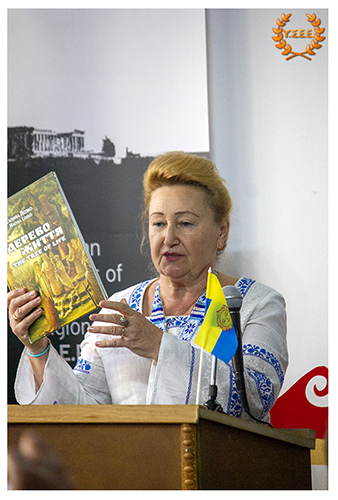 GREETINGS!
I am sincerely glad to welcome you all today at this important international gathering — a Congress that unites us around a common goal:
preserving the identity, spiritual heritage, and national cultures of our peoples. It is a great honour for me to represent Ukraine and the Association of the Believers of the Ukrainian Native Faith (Obiednannia Ridnoviriv Ukrainy – ORU) here.
Such meetings are of immense importance, for they affirm our right to be ourselves, to nurture our traditions, and to pass them on to future generations.
1. Historical Origins of Ukrainian Identity and Native Faith
The Ukrainian ethno-religious tradition has deep roots. As early as the 5th century BCE, the renowned Greek historian Herodotus visited the lands of present-day Ukraine, then known as Scythia, and described them in the fourth book of Melpomene. He mentioned the Hyperborean maidens who brought gifts wrapped in straw to the goddess Artemis in Delphi.
These accounts testify to the ancient and profound spiritual traditions of our land, formed long before the emergence of world religions.
The founder of the revival of the Native Faith in Ukraine
Professor Volodymyr Shaian — the founder of the revival of the Native Faith in Ukraine — emphasized: “We rehabilitate the faith of our Ancestors for history and science.”
This phrase precisely reflects the essence of our work: not to create something new, but to revive the authentic spiritual heritage that forms the foundation of Ukrainian identity.
2. Identity in a Globalized World: Challenges and Threats
The concept of “identity” means continuity, stability, and self-awareness — both individual and collective. In ancient times, identity consisted of three key elements: native land, native language, and native religion (tradition).
These formed the spiritual core of a people’s existence.
In globalized world…
Today’s globalized world seeks to create a multicultural environment that often leads to assimilation and the erosion of national identities. American sociologist Francis Fukuyama noted that in the United States, state policy is aimed not at preserving national identity but at successfully assimilating newcomers.
In the Universal Declaration of Human Rights (1948), there is no article guaranteeing a person’s right to national identity. Nationality as such is not protected in any way.
The concept of a nation is often confused with the concept of citizenship.
For European peoples, such trends are dangerous, as they can result in the loss of cultural diversity.
Universalization
Universalization seeks to impose a single global religion on humanity, which would mean spiritual uniformity and the loss of ethnic roots.
That is why the revival of autochthonous ethnic religions is not just a cultural phenomenon but a strategy for protecting national identity and spiritual diversity.
3. Ukrainian Identity and Native Faith Amid the Russian-Ukrainian War
Today, Ukraine is experiencing an existential war for its very right to exist. The Russian-Ukrainian war has not lasted just 12 years — it has a history of over four centuries. Muscovy has consistently sought to subjugate Rus-Ukraine, to appropriate our history, our name, and our spiritual heritage.
Russia openly declares that its goals are de-Ukrainization, denazification, de-Europeanization, and demilitarization — in other words, the assimilation of Ukrainians into the “Russian” sphere. To achieve this, it employs genocide, repression, the destruction of the Ukrainian language, and the elimination of our spiritual and cultural leaders. Today, we see this manifest as a full-scale war in the 21st century.
The Russian Orthodox Church….
The Russian Orthodox Church plays an active role in Russian aggression, acting as an instrument of Moscow’s influence. Ukrainian security services have repeatedly found weapons, ammunition, pro-Russian symbols, and anti-Ukrainian propaganda in its institutions.
Some clergy have even coordinated the targeting of Russian missiles on civilian sites.
Way to preserve ourselves…
In these tragic circumstances, returning to our own ethno-religious tradition takes on new meaning: it becomes not only a spiritual act but also an act of national resistance — a way to preserve ourselves as a people and protect our identity.
4. Native Faith as an Official Part of Ukraine’s Spiritual Life
The Religious Center of the Association of Believers of the Ukrainian Native Faith is officially recognized by the state and registered by the State Committee for Religious Affairs. Our Statute states that we continue the autochthonous tradition of the ethnic religion of Kyivan Rus’, thus being its heirs. Today, more than 30 local Native Faith communities operate in Ukraine.
We consider it extremely important to spread knowledge about the existence of ethno-religions and the activities of our international institution — the European Congress of Ethnic Religions (ECER) — in scholarly publications and on international information platforms. That is why I publish my research reports on Ukraine’s participation in ECER, including the one for 2023.
5. Revival of Autochthonous Religions as a Strategy for Preserving Cultural Diversity
The revival of Europe’s autochthonous religions is not merely a return to the roots; it is also a strategy for preserving the spiritual and cultural diversity of humankind. The experience of communities such as the Latvian Dievturi demonstrates that a civilized approach to freedom of conscience lies in recognizing the right of ethno-religions to coexist on an equal footing with the world’s major confessions.
The Riga Declaration of the 18th ECER Congress reaffirms this right, emphasizing the equal status of ethno-religions even in an environment dominated by major world religions.
Such principles are essential for preserving national identity, spiritual diversity, and Europe’s cultural memory.
Dear friends!
We live in times of great challenges but also of great opportunities. Today, we have the chance to affirm every nation’s right to its own identity, language, tradition, and spiritual heritage.
The revival of autochthonous religions is not a step backward — it is a path into the future, where diversity is a source of strength rather than division.
I wish all of us
Peace, Justice,
and Spiritual Resilience!
Thank you for your attention!