Speech of 2025/10/03 in Athens by Koenraad Logghe and Brenda Lioris from Traditie VZW (Belgium)

"Ethnic Religions and the Formation of European Identity - Pre-christian heritage of the Low Countries"
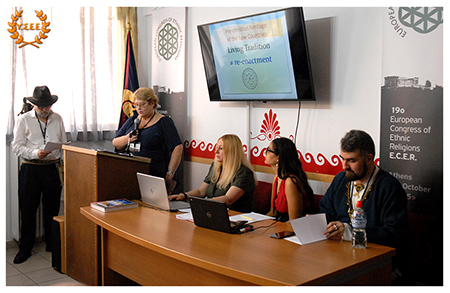 This presentation reflects our thoughts regarding the pre-christian pagan heritage of the Low Countries.
Our organisation,Traditie, values and supports everything that reminds us of the rich pre-christian heritage in our regions.
This implies the study of our folk tales, remnants in our language, folk songs, ancient symbolism on houses, archaeological founds, references in literature, participation in folk festivals…Yet that is not enough.
Just because you can dress up as a Viking, write your name in runes, quote a few verses from the Edda, publicly invoke the Gods and perform some blóts, does not make you a “heathen”.
Just because you stack a few stones on top of each other doesn’t mean you have a house. You must understand something about the construction of that building, know something about the mortar that holds it together, know something about the practical use of the rooms you wish, and something about the purpose of the building as a whole.
The same applies to our heathenism. Collecting disparate pieces does not make heathenism. You need insight, an understanding of the doctrine, and really live that worldview.
No — Traditie is not a reenactment group. Our organisation Traditie goes to the heart of the matter and makes it into a way of life.
The foundation of our heathen tradition is its doctrine.
The spiritual approach from the Low Countries is primarily indebted to the Germanic peoples, but also partly to the Celts. Furthermore, it is embedded in the broader cultural zone referred to as Indo-European. From that, it has its fundamental structure and patterns of thought.
Here you have a map of the different peoples in Europe from the 4th to the 7th century.
In the heathen worldview of that culturally defined region, the Primordial Law (Ørlögr – Dharma) lies at the root of everything. This is the Universal Order established since primordial times.
The guardians of this are the Gods (æsir; in Avesta: aṣ̌a, Old Persian: arta). They are the ones who establish the Order (arta/rtá) based on the Primordial Law.
Order is experienced as life-sustaining, culture-founding. Chaos, on the other hand, is seen as causing rudeness, destruction and death.
The Indo-European peoples have a cyclical vision with systematic degradation and thus alienation from the Primordial Law, culminating in the Ragnarök (the dramatic fate of the Gods).
Since everything that comes into being finds its foundation in the Primordial Law (Ørlögr), everything also has its reason of existence within the story that has been told since primordial times.
In that story, told or sung by the Gods, everything is animated: we may well speak of a form of animism.
Hence everything also has a local task within that Primordial Law. We call this fate.
The love of that Fate (amor fati) is humanity’s task within the whole.
The man (wer / vir) who follows his Fate is courageous (weer-baar / vir-ilis) as he maintains virtue (Wer-te / vir-tus) and coincides with his inner law (waar-achtig, truthful / vir-tute / sva-dharma). He respects and keeps order.
If one deviates from this, one is a coward (veeg / arg (inhuman) / feigr / a-dharma). He denies and rejects order.
The Indo-European traditions do not know morality and sin in the Christian sense, but rather they stress responsibility.
An ethical code only has meaning in light of one’s own path — a path with both light and dark aspects.
Crucial is the preservation of authenticity and truthfulness that establishes unity with the inner Order as reflection of the outer primordial Order.
The dark side, too, belongs to the dynamic of life, just as it was already present in the genesis.
Hence, within existence, everything has its place: Gods, Goddesses, Elves, Dwarves, Giants, Trolls, Water-spirits, Nickars, Monsters, the dead and the living side by side.
Heritage is a tangible expression of this doctrine, in which everything has its place, its purpose, its fate.
It is expressed in our language, stories, festivals, rituals, songs, symbols, worldview, behaviours, and character.
It is identity-forming.
Denying that doctrine is denying our nature, who we truly are.
Behind every word, behind every image, behind every symbol lies a worldview and an attitude to life.
Without that doctrine, there would be no heathenism.
"Whoever knows our spiritual vision, knows themselves. Not as a modern uprooted human, but as an authentic, upright human being."
That is the reason why, in 1992, I – Koenraad Logghe - founded the organization Traditie in the Dutch-speaking Low Countries. Not as a re-enactment group for pseudo-Vikings, but as a group of enthousiastic people who consider the traditional, authentic Northern European way of thinking and living far too important to simply let slip away.
Our current chairman is Herman Vanhove. In his latest article for our Yearbook, he states wisely: "You can’t be everyone’s friend. But a civilized person abides by the rules of civility even towards their enemies." That kind of tought typifies him. This wisdom is to his credit. It characterizes the way in which he has led our organization for decades: with honour and dignity.
Our organization Traditie is committed to the struggle for our language, which is constantly under pressure. Language is not just a means of communication. Behind every word lies a thought, a worldview, an attitude. That is why the preservation of language is so important.
Traditie is committed to the struggle for the preservation of our traditional songs that are in danger of being lost. Our songs express joy, struggle, sorrow, and spiritual disposition. Our dances follow the rhythms of nature, the cyclical awakening and passing, the heartbeat of Mother Earth.
Traditie is committed to the struggle for our storytelling culture, our myths and legends. The Low Countries are richly endowed with folk tales, legends, and myths. Countless creatures have dominated our landscapes, inspired the imagination of both children and adults, and shaped our culture for centuries. Moreover, the art of storytelling itself has been lost. This is what Tradition seeks to recover and to promote. It gives color to our regions and fills them with an ancient yet respectable imagination.
Traditie is committed to the struggle for our ritual practices. Rite is the establishment of Order. It is following the cadence of life and attuning oneself to it. Performing rituals connects us with our metaphysical foundation, with the divine core that guides our lives on a daily basis. Restoring this transcendent connection with the Divine in our lives is a constant mission of our organization.
Traditie is committed to the struggle for our ethical attitude. A virtuous attitude is directed towards decency, towards truthfulness, towards authenticity. Be who you are, and be proud of it—not with arrogance, but with principled steadfastness.
Traditie is committed to the struggle for our way of symbolic expression. Symbols are the expression, in a lower and more figurative form, of something that is almost inexpressible from that higher world. The loss of symbols and of symbolic imagination leads to the destruction of our direct contact with that higher world. It leads first to rationalization, then to contestation, and ultimately to moralization. In this process, the layered dimension of symbolic language is completely lost. Symbols and wonder, symbols and mystery, symbols and speechlessness are inseparably bound together. It is this tradition that we wish to continue.
All of this is part of our struggle for our spiritual fulfillment. And that, dear friends, that has shaped our character, our identity, and ultimately also our strength. That is who we are, and that is what we want to preserve.
I wish you heil, megin and fríð – Blessing, Strength, and Inner Steadfastness.