Speech of 2025/10/03 in Athens by Giuseppe Barbera, Pontifex Maximus of Roman Religion and President of Pietas - Comunità Gentile

"The Ancestral European Religion"
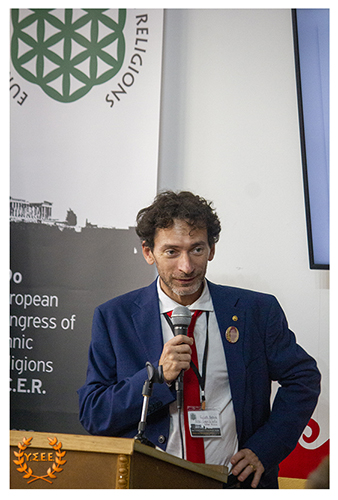 Our presentation focuses on the true European religion or the original religion of Europe. Question: is there a European religion, a religion that unites all European peoples? Yes, and we will demonstrate this in this presentation.
Key points
1- There is a religion common to all peoples of the European continent. It is an ancestral religion, apparently polytheistic in form. We say apparently because the differentiation of religions into polytheistic and monotheistic or henotheistic is a modern convention (by modern and contemporary we mean what refers to the last two millennia of human history, relatively recent times compared to the lifespan of human beings in this world). Furthermore, we believe that true modernity began with the development of science in the Hellenistic period. This convention has its origins in the Aristotelian system, which categorizes the human sciences and human thought for the sole purpose of analysis and study. However, despite the convenience of this system, which has distinguished Western thought from Eastern thought since the Hellenistic period, it is not sufficiently valid and realistic to allow for an essential and fundamental understanding of ancient religious ideals.
2- We therefore need to take a step back and return to the predecessor of the great Aristotle. We must reacquire the Platonic mindset and return to the ideal of the world of ideas as formulated and defined by Socrates, if not go back as far as Parmenides. Be careful, since the rise of Christianity, there has been a tendency to argue that Socrates never existed and that he was a literary invention of Plato in order to develop, through his dialogues, the spread of his ideas. In our opinion, however, this is a Christian propaganda view, which contrasts with the idea that Socrates did indeed exist, while the Jesus Christ described by the evangelists is clearly an imaginary character, created to convey in literary form a selection of previous myths with the aim of establishing a new religious ideal that would be useful to the political unification intentions of the Roman Empire from Constantine onwards. In fact, we all know that Romulus was actually the son of the god Mars and the vestal virgin Rhea Silvia, conceived by the god in a cave. We know of many similar myths. we know that it was the divine emperor Vespasian who cured a blind man by spitting in his eye, we know the myth of Aesculapius who healed the sick and resurrected a dead man but for this reason was killed by Jupiter because he had broken the order of the cosmos, but later, in agreement with Apollo, Aesculapius was resurrected and ascended to heaven, to Olympus, as a deity. Christianity itself therefore draws on this common European religion, and it is precisely because of this parasitism on the energy of the ancestral European tradition that Christianity was able to strengthen and establish itself. It is our intention to identify and understand the original common European religion and to draw from it the common elements that unite the different peoples of Europe. To better understand our vision, we propose a parallel with the Hindu religion. India is a subcontinent, meaning it can be considered a continent in its own right, just as we consider Europe, detached from Eurasia, to be a continent in its own right.
India is actually a nation made up of several states, each with its own history, which were at war with each other in the past but which, over the course of history, found peace in the religious unity of paganism, locally called Hinduism (Sanatana Dharma). Here, myths sometimes change from place to place with slight variations, as in our ancient world. For example, in some areas of India, Ganesh had his head cut off by Shiva because he was guarding the entrance to Parvati's bath, while in other areas, the version has it that it was the god of the planet Saturn who destroyed his face when he stared at him while he was in the arms of his mother Parvati. Thus, Hercules, Minerva, and the other deities of the ancient world had names that changed from city to city, and their myths had local variations. For example, Minerva was Athena in Athens, Asana in Sparta, Minerva in Rome, and Mnerva in Vulci, but everywhere she was the Goddess of Wisdom. The Roman Venus was Aphrodite in Greece, Freya in Germany, Milda in Lithuania, etc. In this awareness of European pagan unity, we can effectively verify that all of us here today share a single religion, characterized not only by essentially similar or identical deities, but also by atavistic cosmic calendar rituals that are closely connected to each other, aimed at maintaining the functioning of the world through the arrival of the gods at their seats at the appropriate times.
For example, during the winter solstice, it is in northern Europe that the Latvians open their doors for the Sun God to enter the world. They traditionally operate within the hour of the astronomical solstice, while we in Italy wait for the astronomical solstice to pass before we can begin the rituals to welcome the coming of the infant Sun into the world. It should not be underestimated that the Latvians called Ianiis the God of the Door that opens at the Solstice for the sun to enter the world, just as Ianus is the name of the God of Doors in ancient Rome and Ianua is the name of his wife, which in Latin also means Door. This is an ancient ancestral rite, where the locally imposed rules, however different they may be (operating within the solstice hour in Latvia, waiting for the solstice hour to pass before operating in Italy), are perfectly organic to a single cosmic ritual in which each community in its locality plays its part for the overall functioning. This shows that in ancient times there must have been an awareness of a religious ritual performed in harmony with other distant peoples. After all, ancient myths often refer to the Hyperborean origins of European peoples who, descending from the north to the Mediterranean, brought with them specific solar cults.
In the Greco-Roman world, coming from the cold northern regions was considered a sign of bliss, so much so that Apollo Hyperboreus is the god who comes from the north to bring peace and bliss to mankind. On May 1, Emperor Augustus, after learning about the different peoples and various rituals of Europe, understood the importance of restoring the festival dedicated to the goddess Flora, during which licentious behavior was permitted. Even today, in Tampere, Finland, the “Queen of May,” an ancient local deity, is celebrated on May 1st. During this festival, young people indulge in Dionysian and venereal behavior. Spring festivals are still held today in Germany, the Czech Republic, and elsewhere on the night between April 30th and May 1st. In the middle of spring throughout Europe, all pagans also celebrate the fertility of the new season.
When the Greeks and Romans began to forge direct relationships with the various European peoples, they realized that the various local deities were very similar to each other, sometimes identical, even in common mythological elements, which today in the historical-religious sphere we call “mythologems.” In these encounters, we do not read about the concept of religious opposition in ancient authors, but we do see an interesting mechanism of encounter, which reaches its apologetic stages in new mythological versions and syncretisms that lead to the construction of shrines dedicated to deities considered common in essence, despite nominal distinctions. Hence the Gallo-Roman and Germanic-Roman shrines, temples dedicated to Jupiter Perun, Hermes Wotan, Venus Freya, etc. The Roman Empire displayed an interesting and healthy approach to religious syncretism in Europe. Europe was a single nation made up of many states (provinces) characterized by what we might today describe as a single religion, using the (unfortunately) inappropriate term “European paganism,” but which for the Romans was the religio of the gentes of Europe. Here, the religions of the European peoples coexisted as a single religion with the well-known phenomena of historical syncretism, characterized by local differences in myths and the apparent forms of rituals, which, however, often conceal a single synchronic, atavistic, cosmic rite, each place with its own priestly and ceremonial organization. We must understand that, like the Hindus in India, we are part of a single European religion characterized by multiple local cults, but linked in essence by the gods and their ancestral cosmic rituals. If we have recovered the ideals of republic and democracy from ancient Rome and ancient Athens (but how much have we managed to restore them today?), we must recover the ideas of religious syncretism and international peace from the ancient Roman and Hellenistic empires.
Thank you.